230
Downloads
Published
License
© Treball Social Journal 2024.
Keywords:
Energy vulnerability energy poverty Home visits Social intervention Social workHow to Cite
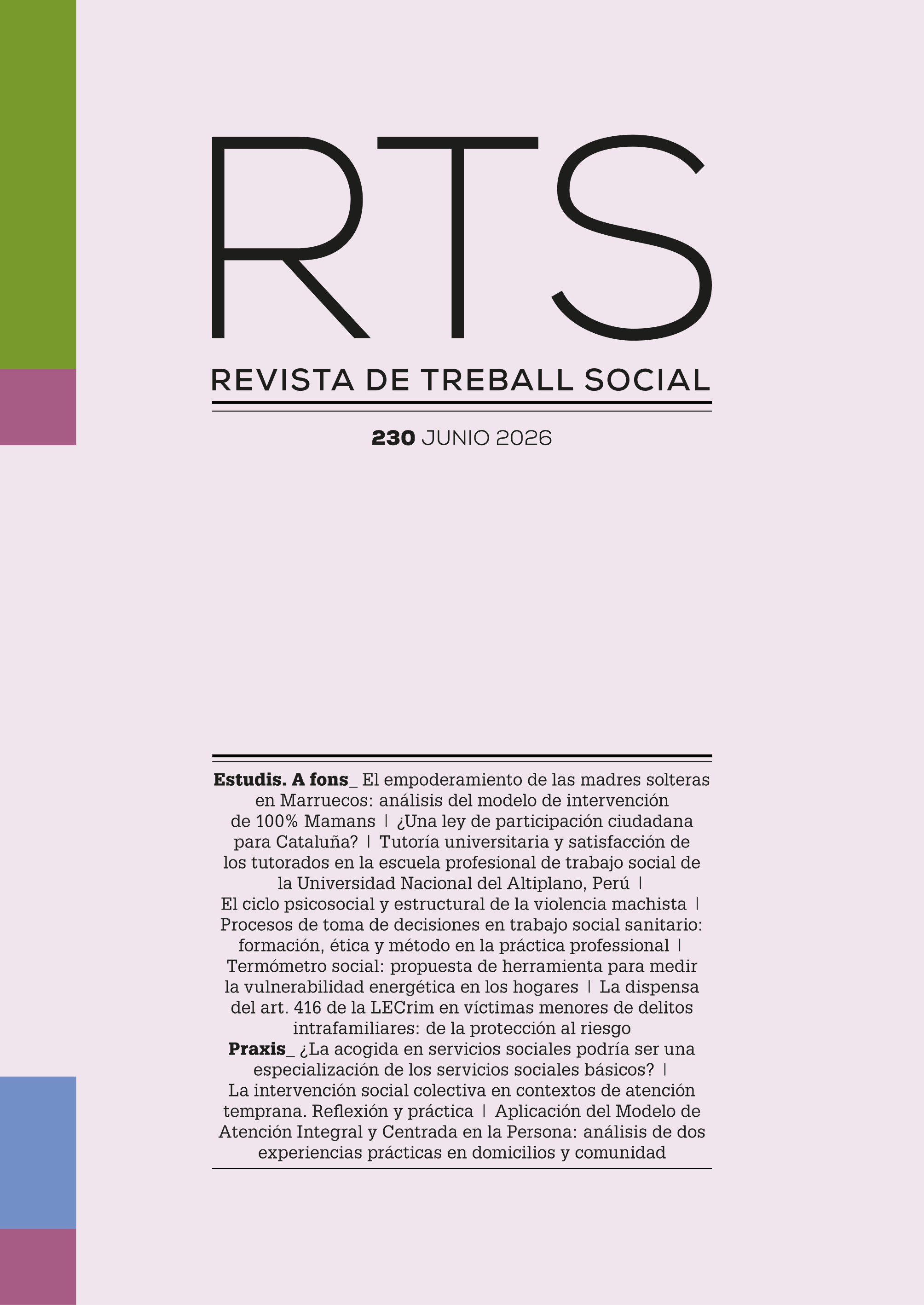
Social thermometer: a proposed tool for measuring energy vulnerability in households
DOI:
https://doi.org/10.32061/RTS2026.230.06Abstract
Energy vulnerability is a concept that goes beyond energy poverty, incorporating not only a lack of economic resources but also structural, social and contextual factors that condition access to and the appropriate use of energy in households. This study aims to develop a methodological proposal to assess energy vulnerability from a social work perspective, through a tool designed for use during home visits.
The research adopts a qualitative approach, based on the analysis of two focus groups with service users and two semi-structured interviews with social work professionals. From this fieldwork, key dimensions were identified and indicators were developed to assess energy vulnerability from a comprehensive perspective. The proposed tool is not limited to facilitating assessments or managing assistance, but seeks to transform social intervention by promoting more contextualised, ethical and needs-based practices for the benefit of service users. This study contributes to raising awareness of an emerging issue and proposes an innovative approach to addressing it within social work.
References
Andrés Camacho, Omar (Ed.). (2025). Documento metodológico para medir la pobreza energética multidimensional en Colombia. Ministerio de Minas y Energía, Gobierno de Colombia. Recuperado 12 mayo 2026, de https://www.minenergia.gov.co/documents/13468/Documento-metodologico-IPEM-MME-2025.pdf
Arenas Pinilla, Eva Maria; Barrella, Roberto; Cosín López-Medel, Álvaro; Linares Hurtado, Jose Ignacio; Romero Mora, Jose Carlos; Foronda Díez, Cecilia, y Díez Alzueta, Leire. (2021). Investigación aplicada para el desarrollo de una herramienta web de cálculo del gasto eléctrico teórico para hogares españoles. Repositorio Comillas. Recuperado 12 mayo 2026, de http://hdl.handle.net/11531/65389
Ávila Cedillo, Guadalupe Jacqueline. (2017). Los instrumentos y técnicas como cuestiones indisolubles en el corpus teórico-metodológico del accionar del trabajador social. Margen, 86, 1-10. https://www.margen.org/suscri/margen86/avila_86.pdf
Baeza Roca, Nuria. (2016). Trabajo social desde la vulnerabilidad energética. Servicios Sociales y Política Social, 37 (monográfico especial), 203-210. https://www.serviciossocialesypoliticasocial.com/trabajo-social-desde-la-vulnerabilidad-energetica
Boetto, Heather. (2016). A transformative eco-social model: Challenging modernist assumptions in social work. The British Journal of Social Work, 47(1). https://doi.org/10.1093/bjsw/bcw149
Bouzarovski, Stefan; Petrova, Saska, y Tirado Herrero, Sergio. (2014). From fuel poverty to energy vulnerability: The importance of services, needs and practices. SSRN Electronic Journal. https://doi.org/10.2139/ssrn.2743143
Chamorro Montes, Paula. (2006). Visita domiciliaria en trabajo social: Un aporte para su aplicación. Revista Electrónica de Trabajo Social, 14, 28-39. https://www.yumpu.com/es/document/view/65885289/visita-domiciliaria-en-trabajo-social
Eurostat. (2024). Condiciones de vida en Europa: Vivienda. Recuperado 12 mayo 2026, de https://ec.europa.eu/eurostat/statistics-explained/index.php?title=Living_conditions_in_Europe_-_housing
Hearn, Adams X.; Mihailova, Darja.; Schubert, Iljana, y Sohre, Annika. (2022). Redefining energy vulnerability, considering the future. Frontiers in Sustainable Cities, 4. https://doi.org/10.3389/frsc.2022.952034
Illescas Taboada, Maribel. (2016). La visita domiciliaria en la protección a la infancia (The home visit in child protection). Trabajo Social Hoy, 79, 27-42. http://dx.doi.org/10.12960/TSH.2016.0014
Jacques Aviñó, Constanza; Dvorzak, Jose Luis; Marí-Dell’Olmo, Marc; Arjona Rodriguez, Dolors; Peralta, Andrés; Carrere, Juli; Benach, Joan; Ramos, Cristina; Plana, Mónica, y López, Maria José. (2019). Qualitative evaluation of an intervention to reduce energy poverty. Revista de Saúde Pública, 53, 62. https://doi.org/10.11606/s1518-8787.2019053001212
Katoch, Om Raj; Sharma, Romesh; Parihar, Sarita, y Nawaz, Ashraf. (2023). Energy poverty and its impacts on health and education: A systematic review. International Journal of Energy Sector Management, 18(2), 411-431. https://doi.org/10.1108/ijesm-10-2022-0007
López Pina, Jose Antonio, y Veas, Alejandro. (2024). Validación de instrumentos psicométricos en ciencias sociales y de la salud: una guía práctica. Anales de Psicología / Annals of Psychology, 40(1), 163-170. https://doi.org/10.6018/analesps.583991
Muzicant, Amit, y Peled, Einat. (2017). Home visits in social work: From disembodiment to embodied presence. The British Journal of Social Work, 48(3), 826-842. https://doi.org/10.1093/bjsw/bcx033
Nouman, Hani, y Cnaan, Raanan A. (2021). Social entrepreneurship in social work: Opportunities for success. Journal of the Society for Social Work and Research, 13(1), 27-46. https://doi.org/10.1086/715441
Peeters, Jef. (2011). The place of social work in sustainable development: Towards ecosocial practice. International Journal of Social Welfare, 21(3), 287-298. https://doi.org/10.1111/j.1468-2397.2011.00856.x
Pellicer Sifres, Victoria. (2018). A broader understanding of fuel poverty from capability approach: towards a characterization built from the bottom-up. Revista Iberoamericana de Estudios de Desarrollo, 7(2), 138-163. https://doi.org/10.26754/ojs_ried/ijds.295
Pellicer Sifres, Victoria. (2023). La pobreza energética: Reflexiones sobre el caso español. Dossieres EsF, 50, 31-36. Dialnet. https://dialnet.unirioja.es/servlet/articulo?codigo=8997564
Romero Mora, Jose Carlos; Barrella, Roberto, y Centeno Hernáez, Efraim. (2024). Informe de indicadores de pobreza energética en España 2023. Repositorio Comillas. Recuperado 12 mayo 2026, de http://hdl.handle.net/11531/95198
Saltiel, David, y Lakey, Rebecca. (2020). Analysing invisibility: The decision-making ecology and home visits. Child & Family Social Work, 25(1), 37-44. https://doi.org/10.1111/cfs.12649
Santillán, Oscar S., y Cedano, Karla G. (2023). Energy literacy: A systematic review of the scientific literature. Energies, 16(21), 7235. https://doi.org/10.3390/en16217235
Scarpellini, Sabina; Hernández Sans, M. Alexia; Llera Sastresa, Eva; Aranda, Juan A., y Rodríguez López, Maria Ester. (2017). The mediating role of social workers in the implementation of regional policies targeting energy poverty. Energy Policy, 106, 367-375. https://doi.org/10.1016/j.enpol.2017.03.068
Sobočan, Ana M.; Bertotti, Teresa, y Strom-Gottfried, Kim. (2019). Ethical considerations in social work research. European Journal of Social Work, 22(5), 805-818. https://doi.org/10.1080/13691457.2018.1544117
Stalker, Carol, y Harvey, Cheryl. (2003). Professional burnout in social service organizations: A review of theory, research and prevention. Universidad Wilfrid Laurier, Partnerships for Children and Families Project. Recuperado 12 mayo 2026, de https://scholars.wlu.ca/pcfp/71/
Thomson, Harriet, y Bouzarovski, Stefan. (2019). Addressing energy poverty in the European Union: State of play and action. EU Energy Poverty Observatory. Recuperado 12 mayo 2026, de https://energy-poverty.ec.europa.eu/system/files/2024-05/paneureport2018_updated2019.pdf
Winter, Karen, y Cree, Viviene E. (2016). Visitas domiciliarias de trabajo social a niños y familias en el Reino Unido: una perspectiva foucaultiana. Revista Británica de Trabajo Social, 46(5), 1175-1190. https://doi.org/10.1093/bjsw/bcv069