230
Downloads
Published
License
© Treball Social Journal 2024.
Keywords:
Single mothers Female empowerment Social exclusion Social intervention 100% MamansHow to Cite
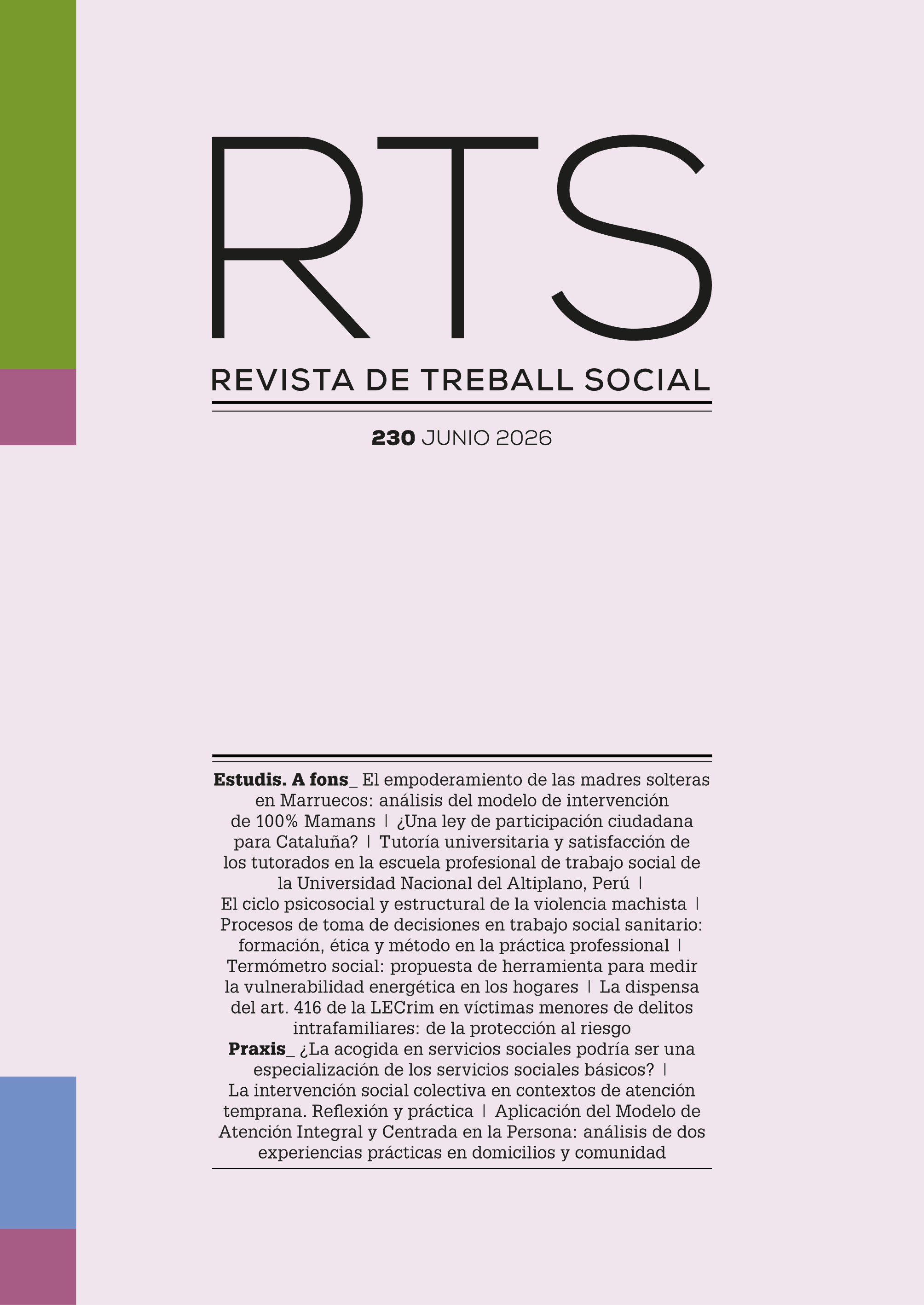
Empowering single mothers in Morocco: analysis of the 100% Mamans intervention model
DOI:
https://doi.org/10.32061/RTS2026.230.01Abstract
This article examines the social intervention model of 100% Mamans and its work to empower single mothers in Morocco. The main objective is to assess how the organisation’s interventions contribute to improving their situation and promote their social, economic and legal inclusion in a context marked by structural discrimination and cultural stigmatisation. Using a qualitative methodology that combines documentary analysis, participant observation and semi-structured interviews with beneficiaries, the psychosocial, educational and legal intervention strategies implemented by the association are examined. The results indicate improvements in self-esteem, financial autonomy and social participation among single mothers. However, barriers such as limited access to funding, centralised services and legal restrictions persist. It is recommended that the 100% Mamans model be replicated in other regions, alongside the promotion of decentralised public policies and reform of the legal framework to ensure the rights of these women and their children.
References
Association 100% Mamans. (2017). Étude juridique. Recuperado 29 marzo 2026, de https://centpourcentmamans.com/wp-content/uploads/2019/11/etudejuridique.pdf
Association 100% Mamans. (2018). Plan de plaidoyer. Recuperado 29 marzo 2026, de https://centpourcentmamans.com/wp-content/uploads/2019/11/plandeplaidoyer.pdf
Association 100% Mamans. (2021). Rapport d’activités année 2021. Recuperado 29 marzo 2026, de https://centpourcentmamans.com/wp-content/uploads/2022/08/RAPPORT-2021-290822.pdf
Association 100% Mamans. (2023). Cartographie des associations œuvrant pour les droits des mères célibataires et de leurs enfants au Maroc. Recuperado 29 marzo 2026, de https://centpourcentmamans.com/wp-content/uploads/2024/05/Cartographie-3.0.pdf
Association Bayti. (2016). La politique publique intégrée de la protection de l'enfance.
Bacqué, Marie-Hélène, y Biewener, Carole. (2013). L’empowerment, un nouveau vocabulaire pour parler de participation? Idées économiques et sociales, 173(3), 25-34. https://doi.org/10.3917/idee.173.0025
Berwick, Laura Victoria. (2017). Single mothers in Morocco: Social stigma and struggle for identity (Tesis de maestría, University of London). https://moroccanchildrenstrust.org/wp-content/uploads/2020/08/Berwick-2017-Single-Mothers-in-Morocco-Social-Stigma-and-Struggle-for-Identity.pdf
Boisson, Marie, y Verjus, Anne. (2004). La parentalité, une action de citoyenneté. Une synthèse des travaux récents sur le lien familial et la fonction parentale (1993-2004) (Dossier d’étude CAF n.º 62). Caisse Nationale des Allocations Familiales.
Bousbaa, Abdelmajid. (2021). Les parentalités en Afrique musulmane : Une parentalité controversée des mères célibataires au Maroc. Centre Jacques-Berque. https://books.openedition.org/cjb/1744
Charlier, Sophie, y Caubergs, Lieve, con el apoyo de Malpas, Nicola, y Mula Kakiba, Evelyn. (2007). Le processus d’empowerment des femmes : Guide méthodologique. Comisión de Mujeres y Desarrollo.
Código de Familia (Moudawana), de 5 de febrero, Dahir n.º 1-04-22 du 12 Hija 1424 (3 febrero 2004), Bulletin Officiel n.º 5184 (2004).
Código Penal Marroquí, de 26 de noviembre, Bulletin Officiel n.º 2640 bis (1962, modificado en 2011).
Constitución del Reino de Marruecos, de 30 de julio, Bulletin Officiel n.º 5964 bis (2011).
Denzin, Norman Kent, y Lincoln, Yvonna Sessions. (2018). The SAGE handbook of qualitative research (5th ed.). SAGE Publications.
Flick, Uwe. (2015). Introducción a la investigación cualitativa (5.ª ed.). Morata.
Humphreys, Cathy, y Thiara, Ravi K. (2003). Mental health and domestic violence: “I call it symptoms of abuse”. British Journal of Social Work, 33(2), 209-226. https://doi.org/10.1093/bjsw/33.2.209
Institut National de Solidarité avec les Femmes en Détresse [INSAF]. (2010). Le Maroc des mères célibataires : Ampleur, réalité, actions, représentations, itinéraires et vécus. Recuperado 29 marzo 2026, de https://www.cawtarclearinghouse.org/storage/4961/INSAF-Rapport-Etude-nationale-%27%27Le-Maroc-des-meres-celibataires-2010.pdf
Kabeer, Naila. (2005). Gender equality and women’s empowerment: A critical analysis of the third Millennium Development Goal. Gender & Development, 13(1),13-24. https://doi.org/10.1080/13552070512331332273
Lahsika, Khalid. (2021). Étude-diagnostic sur les discriminations subies par les mères célibataires dans leurs itinéraires de vie au Maroc. Association 100% Mamans. Recuperado 29 marzo 2026, de https://centpourcentmamans.com/wp-content/uploads/2021/12/Etude-100mamans.pdf
Letablier, Marie-Thérèse. (2011). La monoparentalité aujourd’hui : Continuités et changements. Tendances, défis et nouvelles exigences. L’Harmattan.
Miles, Matthew B. ; Huberman, A. Michael, y Saldaña, Johnny. (2014). Qualitative data analysis: A methods sourcebook (3rd ed.). SAGE Publications.
Moghadam, Valentine M., y Senftova, Laila. (2005). Mesurer l'autonomisation des femmes : participation et droits dans les domaines civil, politique, social, économique et cultural. Revue internationale des sciences sociales, 184(2), 423-449. https://doi.org/10.3917/riss.184.0423
Parazelli, Michel, y Bourbonnais, Mélanie. (2017). L’empowerment en travail social : Perspectives, enseignements et limites. Sciences & Actions Sociales, 6(1), 23-52.
Sechter-Funk, Isabelle. (2015). La maternité célibataire au Maroc, entre normes et pratiques. En Baudouin Dupret, Zakaria Rhani, Assia Boutaleb y Jean-Noël Ferrié (Eds.), Le Maroc au présent (p. 355-364). Centre Jacques-Berque. https://books.openedition.org/cjb/1052
Waltmann, Julie. (2019). La (re)production des inégalités de genre dans le monde du travail : Des discriminations légales à l’autonomisation. Pouvoirs africains et développement, 2, 1-15.
Wendland, Judith. (2010). Grossesse, désir d'enfant et parentalité dans les maternités célibataires à risque. La psychiatrie de l’enfant, 53(1), 167-210. https://doi.org/10.3917/psye.531.0167